
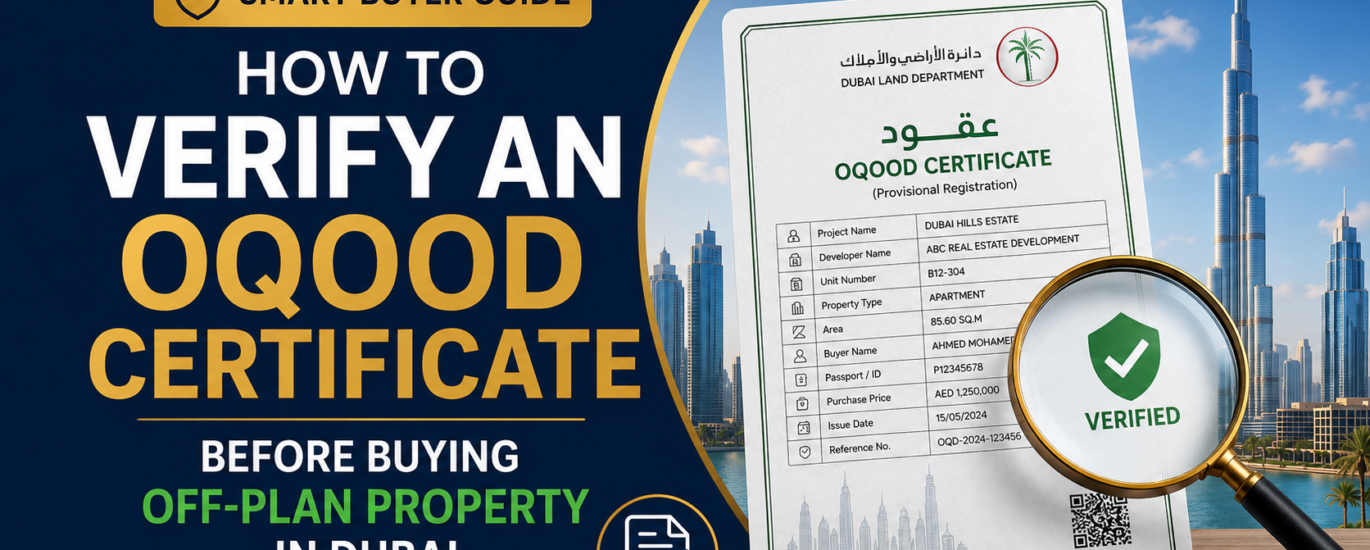
Introduction: Why You Must Verify Oqood Certificate Dubai Before Buying
Buying an off-plan property in Dubai can be a strong investment decision, but only when the buyer checks the paperwork properly. The project may still be under construction. The final title deed may not be issued yet. The payment plan may continue for months or years. This is why every buyer should know how to verify Oqood certificate Dubai before completing an off-plan property purchase.
When you verify Oqood certificate Dubai, you are not just checking a document. You are checking whether the off-plan purchase, buyer details, developer details, project information, and unit details make sense before you pay more money or proceed with resale.
For off-plan buyers, the Oqood certificate is part of the registration trail before final title deed issuance. It helps show that the off-plan transaction has been recorded through the relevant process. However, buyers should not accept screenshots, edited PDFs, verbal promises, or forwarded messages without checking.
At BuiltPulse, we help Dubai property buyers and investors make smarter decisions through proper research, documentation awareness, and real estate advisory. If you are buying off-plan, learning how to verify Oqood certificate Dubai should be part of your due diligence.
If you are new to the buying process, start with BuiltPulse’s full guide on how to buy property in Dubai.
What Is an Oqood Certificate in Dubai?
Before learning how to verify Oqood certificate Dubai, you need to understand what the certificate means.
An Oqood certificate is connected to off-plan property registration in Dubai. Oqood means “contracts” in Arabic. In real estate, it is commonly used for registering off-plan sale contracts before the property is completed and before the final title deed is issued.
Dubai Land Department’s official “Request to register the initial sale” service explains that the process is accessed through the Real Estate Developers Portal — Oqood. The procedure includes selecting provisional sale registration, entering property details, attaching documents, selecting payment method, submitting the application online, and receiving the output by email. Official source: DLD Request to Register the Initial Sale.
Simple Meaning of an Oqood Certificate
- It is connected to off-plan property registration.
- It is used before the final title deed stage.
- It helps record the buyer’s off-plan purchase.
- It gives a provisional registration trail.
- It supports buyer documentation.
- It should match the Sale and Purchase Agreement.
- It should match the buyer, unit, project, and developer details.
When you verify Oqood certificate Dubai, you are checking whether this registration evidence is consistent, authentic, and aligned with official information.
Why It Is Important to Verify Oqood Certificate Dubai
You should verify Oqood certificate Dubai because off-plan buyers often pay before the property is completed. That creates a period where buyers need stronger document control.
Verification Helps Buyers Avoid
- Fake or edited documents
- Wrong unit details
- Wrong buyer name
- Wrong project name
- Wrong developer name
- Unclear registration status
- Payment to incorrect accounts
- Resale delays
- Handover confusion
- Future title deed issues
A buyer should never rely only on a brochure or payment plan. You need to verify documents, project details, escrow information, and official records where possible.
If you want a wider cost and risk checklist, read BuiltPulse’s article on hidden costs when buying property in Dubai.
How to Verify Oqood Certificate Dubai: Quick Checklist
Before going into the detailed steps, here is a quick checklist.
To verify Oqood certificate Dubai, check:
- Buyer name
- Passport or Emirates ID details
- Developer name
- Project name
- Unit number
- Property size
- Purchase price
- Registration or certificate reference
- Issue date
- Developer confirmation
- DLD or Dubai REST project status
- Escrow account details
- Payment receipts
- SPA details
- Broker or agent license, if applicable
A genuine verification process is not one single step. It is a group of checks that work together.
Step 1: Match the Oqood Certificate With the SPA
The first step to verify Oqood certificate Dubai is to compare the certificate with the Sale and Purchase Agreement.
Your SPA is the main contract between buyer and developer. The Oqood certificate should not conflict with it.
Check These Details
| Detail | What to Compare |
|---|---|
| Buyer name | Must match passport or Emirates ID |
| Project name | Must match the SPA and developer documents |
| Developer name | Must match the official developer |
| Unit number | Must be exactly the same |
| Floor number | Should match the SPA and floor plan |
| Property size | Should match the agreed unit details |
| Purchase price | Should match or clearly align with the SPA |
| Payment plan | Should not conflict with signed terms |
| Issue date | Should make sense based on transaction timeline |
Red Flags
Be careful if:
- The buyer name is misspelled.
- The unit number is different.
- The project name is incomplete.
- The developer name is different.
- The price does not match.
- The certificate is only shared as a low-quality screenshot.
- The seller refuses to provide supporting documents.
If any detail does not match, pause the transaction and ask for clarification.
Step 2: Ask the Developer to Confirm the Oqood Certificate
The second step to verify Oqood certificate Dubai is to contact the developer directly.
Do not rely only on the agent, seller, or broker. The developer is usually the party that handles or initiates off-plan registration through the relevant Oqood process.
What to Ask the Developer
- Is this Oqood certificate valid?
- Is the buyer name recorded correctly?
- Is the unit number correct?
- Is the project name correct?
- Is the seller allowed to resell the unit?
- What payment percentage has been completed?
- Are there outstanding payments?
- Are there developer transfer fees?
- Is an NOC required for resale?
- Are there any restrictions on the unit?
Why Developer Confirmation Matters
Developer confirmation helps buyers avoid:
- Fake resale claims
- Unapproved transfer attempts
- Outstanding payment surprises
- Unclear unit ownership trail
- Resale delays
- Future registration problems
If you need professional help asking the right questions, explore BuiltPulse’s sales, leasing, and advisory services.
Step 3: Check Dubai REST for Project Details
The third step to verify Oqood certificate Dubai is to check project-related details through official channels such as Dubai REST.
Dubai REST is the official smart real estate platform by Dubai Land Department. DLD states that Dubai REST provides real-time off-plan project information, including completion percentages, actual project photos, escrow account numbers, and payments due for invested projects. Official source: Dubai REST Real Estate Services.
What to Check on Dubai REST
- Project name
- Developer details
- Completion percentage
- Actual project photos
- Escrow account number
- Payment information
- Project status
- Broker or office information, where relevant
Why This Helps
Dubai REST helps you avoid relying only on marketing promises. When you verify Oqood certificate Dubai, you should also verify whether the project itself looks official, active, and consistent with what the seller or developer told you.
You can also review the official Dubai REST service page.
Step 4: Use DLD Project Status Enquiry
Another useful way to verify Oqood certificate Dubai is to check the project’s status through Dubai Land Department’s official project status tools.
DLD’s Project Status Enquiry service allows customers to inquire about real estate project completion percentage and details in Dubai. Official source: DLD Project Status Enquiry.
What Project Status Can Help You Check
- Whether the project appears in official records
- Construction progress
- Developer details
- Project status
- Completion percentage
- Whether the project information matches the Oqood certificate
Buyer Tip
Do not verify the Oqood certificate in isolation. Always verify the project too. A document may look professional, but the project details should also match official information.
For investment-area comparison, read BuiltPulse’s guide on the highest ROI areas in Dubai.
Step 5: Check Escrow Account Details
To verify Oqood certificate Dubai, buyers should also confirm escrow account details.
Escrow is important because off-plan payments should be connected to the approved project account, not informal or personal accounts. Dubai REST can show escrow account information for off-plan projects, according to DLD’s official Dubai REST information.
Escrow Details to Check
- Project escrow account number
- Developer name linked to escrow
- Project name linked to escrow
- Payment instructions
- Bank details
- Whether previous payments were made correctly
- Whether future payments go through the official route
Red Flags
Be careful if:
- You are asked to pay into a personal account.
- The escrow account name does not match the project.
- Payment instructions are only sent by WhatsApp.
- No official receipts are available.
- The seller cannot show payment history.
- The developer refuses to confirm outstanding dues.
When you verify Oqood certificate Dubai, escrow verification helps protect your money and confirms whether the payment trail is clean.
Step 6: Verify the Broker or Agent License
If a broker or agent is involved, you should verify their license and permit before paying or signing.
Dubai Land Department provides a service to verify licenses and permits issued for real estate activity practitioners through the Trakheesi system. Official source: DLD Verify License and Permits.
What to Check
- Broker name
- Brokerage company
- RERA or license details
- Advertisement permit, if applicable
- Whether the agent is authorized
- Whether the listing is legitimate
- Whether the property details match the documents
Why This Matters
Even if the Oqood certificate seems correct, a buyer can still be exposed to risk if they deal with an unauthorized or misleading intermediary.
A reliable agent should not object to verification.
Step 7: Check Payment Receipts and Outstanding Dues
If you are buying an off-plan resale, you must check payment history. This is a major part of how to verify Oqood certificate Dubai before buying from an existing buyer.
Ask for These Documents
- Original booking receipt
- Down payment receipt
- Oqood payment receipt
- Instalment receipts
- Escrow transfer confirmations
- Developer statement of account
- Outstanding payment schedule
- Late payment notices, if any
- Developer NOC requirements
Why This Protects You
If the seller has unpaid dues, late penalties, or missed instalments, you may face problems during transfer. Always ask the developer for an updated statement.
For a detailed breakdown of buyer expenses, read BuiltPulse’s post on hidden costs when buying property in Dubai.
Step 8: Check If Resale Is Allowed
Many buyers verify the Oqood certificate but forget to check whether resale is allowed. This is especially important for off-plan properties.
Before buying from an existing off-plan buyer, ask the developer:
- Is resale allowed?
- What percentage must be paid before resale?
- Are there transfer fees?
- Is a developer NOC required?
- Are there outstanding dues?
- Is there any lock-in period?
- Does the buyer need to clear payments first?
- Can the transfer be completed now?
Why This Matters
You may verify Oqood certificate Dubai and still face a problem if the developer does not allow resale yet. Oqood verification and resale eligibility are connected, but they are not the same thing.
Step 9: Check Title Deed Verification for Completed or Near-Handover Units
For off-plan property, buyers normally deal with Oqood before final title deed issuance. But if the property is completed, near handover, or being sold after completion, you should also understand title deed verification.
Dubai Land Department provides a title deed verification service that allows customers to verify the validity of a Certificate of Title or Title Deed issued by DLD. Official source: DLD Verify Title Deed.
When to Use Title Deed Verification
- The property is already completed.
- The seller claims title deed has been issued.
- The transaction is no longer purely off-plan.
- You are buying after handover.
- You need to verify ownership documents.
Buyer Tip
For off-plan property, check Oqood and project status. For completed property, check title deed validity. If the transaction is between both stages, check both.
Step 10: Keep a Complete Verification File
After you verify Oqood certificate Dubai, keep every document in one organized folder.
Keep These Documents
- Oqood certificate
- SPA
- Booking form
- Payment receipts
- Escrow transfer confirmations
- Developer statement of account
- Developer emails
- Broker license proof
- Project status screenshots or reports
- Dubai REST project details
- Resale NOC, if applicable
- Passport or Emirates ID copies
- Floor plan
- Payment plan
- Handover notices
- Final title deed after completion
Why This Matters
A complete file helps you:
- Avoid confusion
- Prepare for resale
- Resolve disputes
- Track payments
- Prepare for handover
- Support mortgage review
- Prove transaction history
- Check future ownership documents
BuiltPulse’s real estate operations and management services can help investors and owners manage property decisions beyond the purchase stage.
Oqood Certificate Verification Table
| Verification Step | What to Check | Why It Matters |
|---|---|---|
| SPA comparison | Buyer, unit, price, project, developer | Confirms document consistency |
| Developer confirmation | Registration status and resale eligibility | Reduces fake document risk |
| Dubai REST | Project status, escrow, completion | Confirms official project information |
| Project Status Enquiry | Completion percentage and project details | Helps validate project activity |
| Escrow account | Official payment route | Protects payment trail |
| Broker license | Agent and permit validity | Reduces intermediary risk |
| Payment receipts | Paid and outstanding amounts | Avoids hidden dues |
| Resale rules | NOC, transfer conditions, fees | Prevents transfer delays |
| Title deed verification | Completed-property ownership document | Useful after handover |
| Document file | Full transaction record | Supports future resale/handover |
Common Mistakes Buyers Make When Verifying Oqood Certificate Dubai
Mistake 1: Accepting a Screenshot
A screenshot can be edited. Always ask for proper documents and developer confirmation.
Mistake 2: Not Checking the Unit Number
One wrong digit can create a serious issue. Match the unit number across all documents.
Mistake 3: Not Contacting the Developer
The seller or agent may sound confident, but the developer should confirm the status.
Mistake 4: Ignoring Escrow Details
If payments were not made correctly, the transaction can become risky.
Mistake 5: Forgetting Resale Rules
A valid Oqood certificate does not automatically mean resale is allowed immediately.
Mistake 6: Not Checking Broker License
Always verify the agent or broker if one is involved.
Mistake 7: Not Keeping Proof
After you verify Oqood certificate Dubai, save everything. Do not rely on memory or chat messages.
Mistake 8: Rushing Because of “Limited Offer”
Pressure is common in real estate sales. A serious buyer verifies first and pays later.
If you need help reviewing the full buying decision, read BuiltPulse’s guide on choosing a real estate consultant in Dubai.
Red Flags Before Buying Off-Plan Property in Dubai
Be careful if you notice these red flags:
- Seller refuses to share Oqood certificate.
- Seller shares only a blurred screenshot.
- Developer does not confirm the document.
- Unit details do not match the SPA.
- Payment receipts are missing.
- Escrow account details are unclear.
- Agent license cannot be verified.
- Project status is hard to confirm.
- Buyer name is different from seller name.
- Seller pressures you to pay immediately.
- Resale eligibility is not confirmed.
- Outstanding dues are not disclosed.
- The price is far below market without explanation.
If you see any of these signs, pause the transaction and get advice.
You can contact BuiltPulse through the BuiltPulse contact page before moving forward with an off-plan property purchase.
How BuiltPulse Helps Buyers Verify Oqood Certificate Dubai
At BuiltPulse, we help buyers and investors understand the practical side of Dubai real estate transactions.
BuiltPulse can support buyers with:
- Off-plan project comparison
- Developer review
- Document checklist guidance
- Oqood certificate awareness
- Payment plan review
- Escrow verification questions
- Resale rule checks
- Market price comparison
- Buyer risk review
- Investment advisory
- Handover planning
- Property ownership guidance
BuiltPulse does not only help buyers find property. The goal is to help buyers understand the full decision, including paperwork, price, payment schedule, risk, resale rules, and long-term value.
You can explore BuiltPulse services, view BuiltPulse projects, or read more insights on the BuiltPulse blog.
BuiltPulse Contact Details
If you want guidance before buying off-plan property in Dubai, contact BuiltPulse:
- Phone: +971-4-225 8226
- Email: info@builtpulse.com
- Office: Office 1601, Court Tower, Business Bay, Dubai, UAE
- Contact page: Contact BuiltPulse
BuiltPulse helps buyers move from confusion to clarity by asking the right questions before money is paid.
Buyer Checklist: Verify Oqood Certificate Dubai Before Paying
Use this checklist before paying a deposit or transfer amount.
Document Checks
- Oqood certificate received
- SPA received
- Booking form received
- Floor plan received
- Payment plan received
- Receipts received
- Developer statement received
- Resale NOC requirement confirmed
Detail Checks
- Buyer name matches
- Seller name matches
- Unit number matches
- Project name matches
- Developer name matches
- Purchase price matches
- Payment schedule matches
- Outstanding dues confirmed
Official Checks
- Dubai REST checked
- Project status checked
- Escrow account checked
- Broker license checked
- Title deed checked if completed
- Developer contacted directly
- DLD services reviewed where applicable
Risk Checks
- Resale allowed
- Transfer fees confirmed
- Payment route confirmed
- No personal-account payment
- No missing receipts
- No unexplained discount
- No pressure to pay before verification
Questions to Ask Before Buying Off-Plan Property
Before buying, ask:
- Can I see the Oqood certificate?
- Can the developer confirm the Oqood certificate?
- Does the unit number match the SPA?
- Does the buyer name match the seller?
- Are all payments up to date?
- Is resale allowed now?
- What payment percentage is required before transfer?
- Is a developer NOC required?
- Are there any penalties or late fees?
- Is the escrow account correct?
- Can I check the project on Dubai REST?
- Is the broker licensed?
- Are there admin or transfer fees?
- Is the final title deed already issued?
- What documents will I receive after transfer?
These questions help buyers verify the transaction properly before paying.
Final Thoughts: Verify First, Pay Later
Off-plan property can be a strong opportunity in Dubai, but only when buyers check documents carefully. Before buying, always verify Oqood certificate Dubai, confirm project details, check escrow account information, speak to the developer, and review all payment documents.
A smart buyer does not only ask, “What is the price?”
A smart buyer asks:
- Is the Oqood certificate valid?
- Is the project official?
- Is the escrow account correct?
- Is the seller allowed to resell?
- Are payments up to date?
- Are the documents consistent?
- Is the broker licensed?
- What happens after I pay?
When you verify Oqood certificate Dubai, you protect yourself from avoidable risk and make a more confident buying decision.
At BuiltPulse, we help buyers and investors make better Dubai real estate decisions with practical advisory, documentation awareness, and market insight.
Explore our services, read more on the BuiltPulse blog, or contact BuiltPulse for professional real estate guidance in Dubai.
FAQs About How to Verify Oqood Certificate Dubai
1. How do I verify Oqood certificate Dubai?
To verify Oqood certificate Dubai, compare it with the SPA, contact the developer, check project details through Dubai REST or DLD project status tools, confirm escrow account information, and review payment receipts.
2. Can I verify an Oqood certificate online?
Buyers can use official Dubai Land Department services and Dubai REST to check project-related information. For the certificate itself, buyers should also request developer confirmation and official documentation.
3. What details should I check on an Oqood certificate?
Check buyer name, project name, developer name, unit number, floor, property size, purchase price, issue date, and certificate reference details.
4. Is an Oqood certificate the same as a title deed?
No. An Oqood certificate is linked with off-plan registration before completion. A title deed is usually issued after final ownership registration for a completed property.
5. Why should I check Dubai REST before buying off-plan?
Dubai REST can provide off-plan project information such as completion percentage, actual project photos, escrow account number, and payments due, which helps buyers verify project details.
6. Should I contact the developer before buying off-plan resale?
Yes. Always contact the developer to confirm Oqood status, outstanding payments, resale eligibility, transfer fees, and NOC requirements.
7. What if the seller only gives me a screenshot?
Do not rely only on screenshots. Ask for proper documents, developer confirmation, payment receipts, and official project checks.
8. How do I verify a broker before buying?
Use Dubai Land Department’s official license and permit verification service through Trakheesi to check real estate activity practitioners and related permits.
9. What if the property is already completed?
If the property is completed, use DLD’s title deed verification service to check the validity of the Certificate of Title or title deed.
10. Can BuiltPulse help me verify Oqood certificate Dubai?
Yes. BuiltPulse can help buyers understand off-plan documents, compare project details, ask developer questions, review payment risks, and make better property decisions.